
'China wants to control and divert rivers.'

United States President Donald Trump boards Air Force One for his return home following diplomatic engagements in Beijing.
'Ladakh is a tiny salami-slice issue.' 'The big one for China is Arunachal Pradesh, more than 83,000 sq km.' 'Do they imagine they can grab any of this by force?' 'In the 21st century, nursing those thoughts only means you need to get your heads examined.' 'It isn't going to happen,' declares Shekhar Gupta.

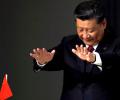
And while delegates from all over China attended the National People's Congress, all eyes were on one man, the anointed-by-personal-diktat ruler for life, Xi Jinping.

US President Donald Trump has claimed that China has committed to halting weapon supplies to Iran, following his personal diplomatic interventions with Chinese President Xi Jinping.

Bangladesh-China and Bangladesh-US relations have evolved from reluctant engagement to increasingly consequential strategic partnerships.

Modi was received at the venue by Chinese President Xi Jinping and First Lady Peng Liyuan. On arrival, the Prime Minister exchanged greetings with the Chinese President before joining other leaders for the customary family photo session.

Donald Trump asked countries involved in the peace talks with Iran to sign on to the Abraham Accords, which deal with establishing diplomatic, economic and security ties between Israel and Arab nations.

If Xi Jinping can establish control over the PLA Ground Force, relations between India and China will settle down to an even keel. The next few weeks will show whether Xi has finally succeeded in gaining control over the PLA Ground Force. That could bring about the substantive shift in India-China relations that both our leaders have been working for, observes Ambassador Prabhat Shukla.

'It beggars belief that Saudi Arabia would deploy military force against India, a top partner and market.'
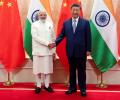
Chinese Foreign Minister Wang Yi has called on India and China to view each other as partners rather than rivals, emphasising the importance of cooperation for regional stability and development.

Prime Minister Narendra Modi raised concerns about cross-border terrorism with Chinese President Xi Jinping, advocating for India-China cooperation to combat the threat. The discussion occurred during the SCO Summit amidst efforts to rebuild bilateral relations after a border standoff.
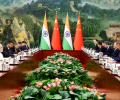
Chinese President Xi Jinping told Prime Minister Narendra Modi that India and China should approach their relations from a "strategic" and "long-term perspective" during their talks in Tianjin. Xi also emphasized upholding multilateralism and working towards a multipolar world.
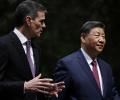
China on Friday raised its additional tariffs on imports from the United States to 125 per cent in retaliation to the Trump administration's 145 per cent levies on Chinese exports.

Before they commanded nations, commanded armies... or commanded headlines, these world leaders once led lives that were unexpectedly ordinary.

'The longer India hangs out to dry, the worse the New Delhi-Washington relationship gets.'

Indian benchmark equity indices, Sensex and Nifty, saw gains in early trade, driven by strong performance in banking shares and positive sentiment from Asian markets, alongside optimism surrounding the ongoing US-China Summit.

Chinese leaders, including its generals, will have to weigh whether they can win a war if they ever attack Taiwan and if at all, can they sustain the subsequent devastation, notes Rup Narayan Das.

Pakistan's Army Chief Field Marshal Asim Munir met with Chinese President Xi Jinping, along with Pakistani Prime Minister Shehbaz Sharif, to discuss bilateral and regional cooperation. The meeting occurred during Sharif's visit to China for the Shanghai Cooperation Organisation (SCO) summit.

The joint statement was issued during Pakistan Prime Minister Shehbaz Sharif's recent visit to China.

The Bloomberg report suggests that this backchannel communication from President Xi has laid the groundwork for a broader thaw in relations. This overture has since translated into a series of tangible diplomatic actions leading up to the upcoming Shanghai Cooperation Organisation (SCO) summit.

On July 10, 2024, Bangladesh Prime Minister Sheikh Hasina met Chinese President Xi Jinping and her Chinese counterpart Li Qiang in Beijing.

Poland's Secretary of State, Wladyslaw T Bartoszewski, has credited Prime Minister Narendra Modi with preventing Russian President Vladimir Putin from using tactical nuclear weapons in Ukraine in late 2022, highlighting Modi's significant influence on the Russian leader.

Dhaka and Beijing on Thursday agreed to strengthen cooperation on the management of the Teesta and other rivers and signed 13 agreements to bolster bilateral ties following talks between Bangladeshi Prime Minister Tarique Rahman and Chinese Premier Li Qiang.

India and China held constructive talks on the situation along the Line of Actual Control (LAC) in eastern Ladakh, emphasising that maintaining border peace and tranquillity enabled progress in normalising overall relations.
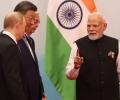
Bolton slammed Trump's tariff policy, asserting that it has "shredded" decades of Western efforts to align India away from its Cold War ties with the then Soviet Union (Russia) and address the growing threat from China.
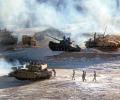
While tensions have eased at several friction points and mechanisms for managing the boundary have been reactivated, underlying differences persist. Disputes over naming practices in Arunachal Pradesh, continued infrastructure development on both sides, and unresolved questions regarding patrolling rights indicate that the structural gap remains, notes Dr Kumar.
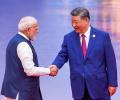
Prime Minister Narendra Modi and Chinese President Xi Jinping held talks focusing on rebuilding bilateral relations, emphasizing border peace and addressing cross-border terrorism.

For India, the guiding principle should remain clear: Engage Bangladesh as a sovereign nation and society rather than through the prism of any individual leader or political party, suggests Manoj Mohanka.

The US has seized an oil tanker, 'Skywave', linked to Iran in the Indian Ocean, as part of efforts to disrupt Iran's oil shipments and enforce sanctions. The vessel was part of a network transporting sanctioned Iranian crude oil, with the seizure occurring amid heightened tensions between Washington and Tehran.

Gearing up for Trump 2.0 era, Chinese President Xi Jinping on Tuesday cautioned there will be no winner in a tariff or tech wars between China and the United States and vowed that Beijing would firmly safeguard its interests.
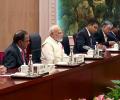
India is committed to taking forward its ties with China based on mutual trust, respect and sensitivity, Prime Minister Narendra Modi told Chinese President Xi Jinping as the two leaders held wide-ranging talks to reset the bilateral relations.

Ranbir Kapoor, Google CEO Sundar Pichai, and acclaimed chef Vikas Khanna have been named among TIME magazine's 100 most influential people for 2026.
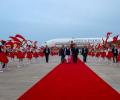
Prime Minister Narendra Modi arrived in China for the Shanghai Cooperation Organisation (SCO) summit. His meeting with President Xi Jinping is significant given global economic concerns.
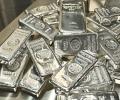
Silver and gold prices snapped a two-day rebound and declined sharply up to 10 per cent in the futures trade on Thursday amid weak trends in the international markets and a strong US dollar.

Prime Minister Narendra Modi and Chinese President Xi Jinping are set to meet in Tianjin on Sunday, their first in about 10 months, for wide-ranging talks aimed at improving relations.

Prime Minister Narendra Modi is visiting Japan and China to further national interests and build cooperation for regional and global peace.

Beijing clearly intends to extend the China-Myanmar Economic Corridor to Bangladesh as part of its larger Maritime Belt and Road Initiative to boost its Indian Ocean presence.

'China continues to perceive its relations with India through the prism of India-US relations, with the US using India to counter balance against China in the Indo-Pacific and beyond.'
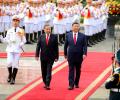
'A small boat with a single sail cannot withstand the stormy waves, and only by working together can we sail steadily and far,' Xi told the Vietnamese leadership.
